Summary
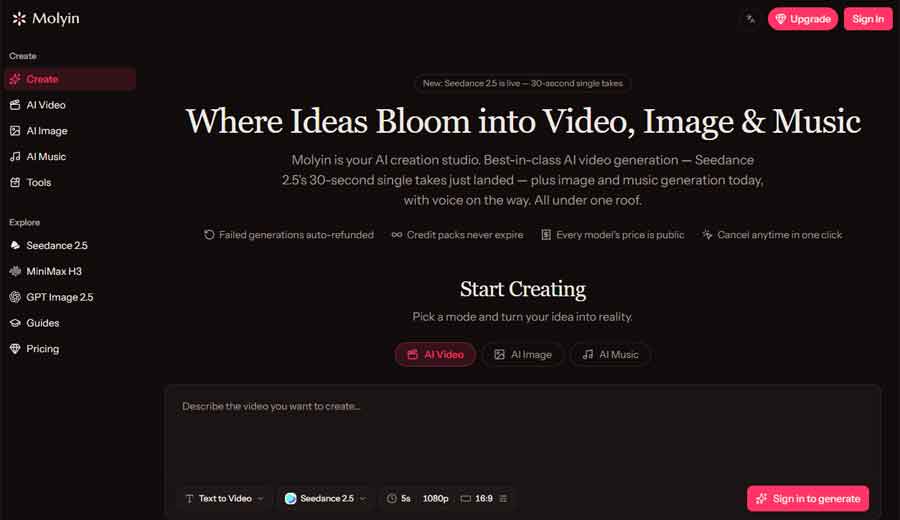
Molyin is an all-in-one AI creation platform that puts video, image, and music generation behind a single credit balance instead of separate subscriptions.
It runs third-party models like Seedance 2.5, Kling 3.0, Veo 3.1, Nano Banana 2, and Suno 5.5 rather than building its own, so the real value is in the unified workflow and transparent per-model pricing, not a proprietary engine.
It’s worth it for creators who currently juggle two or three separate AI tools and want one login and one shared credit pool instead. It’s a weaker fit for anyone who wants a single best-in-class model at the lowest possible per-second cost, since aggregators pass through the underlying providers’ compute costs plus a margin.
As a very new platform with no independent review history yet, it’s best approached with a small credit pack first rather than a yearly plan.
Quick Facts
| Category | Detail |
|---|---|
| Price | Free plan with 10 credits; paid plans from $4.99/month (billed yearly) to $645/month; one-time credit packs from $4.99 to $1,499 |
| Signup required | Yes, to generate (a free account with 10 welcome credits) |
| Platform | Web-based (browser), no desktop or mobile app found |
| Standout feature | One shared credit balance across video, image, and music generation, with every model’s per-second credit rate published openly |
| Best for | Creators and small teams who want to switch between multiple AI models without separate subscriptions |
| Worth knowing | Molyin doesn’t build its own AI models — it’s a front end for Seedance, Kling, Veo, Nano Banana, GPT Image, and Suno, among others |
What Is Molyin
Molyin is a web-based AI content studio that launched with a focus on AI video generation and has since expanded into image and music tools, with voice generation listed as coming next.
Rather than training its own models, it licenses access to a roster of existing ones: ByteDance’s Seedance line, Kling, Google’s Veo, Alibaba’s HappyHorse, MiniMax’s H3, Nano Banana, GPT Image, FLUX, and Suno, and routes them all through one interface and one credit balance.
The pitch is consolidation. Most AI tools do one thing in one place, a video generator here, an image model there, a music app somewhere else, and Molyin’s stated alternative is one AI creation platform where every modality shares the same studio, credit balance, and library.
The company frames its long-term goal as building toward creative agents that chain these tools together to handle a full brief end to end, though that part of the product isn’t live yet. Molyin
There’s a naming issue worth flagging directly. Molyin (molyin.com) has no connection to Molin AI (molin.ai), an unrelated e-commerce chatbot company. Anyone searching for reviews should double-check they’re reading about the right product, since the names differ by a single letter and search results mix the two easily.
Molyin’s own about page leans heavily into brand storytelling drawn from the Greek myth of Circe and the herb moly, and it’s genuinely light on hard company facts. There’s no founder name, no headquarters location, and no team size disclosed anywhere on the site that could be verified for this review.
That’s not unusual for an early-stage product, but it does mean prospective users are trusting a young, low-transparency company with payment details and creative files.
Key Features
- Unified credit system across modalities. Video, image, and music generation all draw from the same credit balance, so switching tools doesn’t mean switching subscriptions.
- Seedance 2.5 with 30-second single takes. The newest video model on the platform generates continuous 30-second clips with native audio, a longer single shot than most competing AI video tools currently offer.
- Multiple video models in one place, including the Seedance 2.0 family (standard, Fast, and Mini variants), Kling 3.0, Veo 3.1, MiniMax H3, and Alibaba’s HappyHorse, each with a different price-to-quality tradeoff.
- Image generation via Nano Banana 2, GPT Image 2, and the FLUX2 family, with FLUX 3 and Muse Image listed as upcoming additions.
- AI music generation with Suno 5.5 and Google Lyria 3, turning a text prompt into a finished track.
- Reference-to-video support on every plan, letting users feed in a reference image or clip to guide style, character, or motion.
- Published, per-model credit rates. The credit rate for every model at every resolution is listed publicly, down to credits-per-second, rather than buried behind vague “generation” pricing.
- Automatic refunds on failed generations. If a generation errors out, the credits spent on it are returned to the account automatically, without needing to file a support request.
- A suite of secondary editing tools, including background removal, video upscaling, subtitle removal, object removal, lip sync, video reframe, and virtual try-on video, most of which are typically standalone paid tools elsewhere.
- Never-expiring credit packs. One-time credit purchases don’t expire, separate from subscription credits which reset monthly and lapse at cancellation.
Who Should Use Molyin?
Molyin fits creators who already bounce between two or three separate AI generation tools and are tired of managing that many subscriptions and workflows.
A social media manager producing short-form video, thumbnail images, and background music for the same campaign can do all three without leaving the platform or re-learning a new interface for each task.
It also suits people who want to compare AI models before committing, since the platform’s transparent per-model credit rates make it easy to see, for example, that a 5-second Seedance 2.0 Fast clip at 480p costs a fraction of what a 5-second Seedance 2.5 clip at 1080p costs. That kind of side-by-side pricing is rare in this category.
It’s a poor fit for two groups. First, anyone who wants the single cheapest way to generate large volumes of one specific type of content, since going direct to a model provider or a specialized single-purpose tool usually undercuts an aggregator’s markup.
Second, anyone who needs a long operating track record before trusting a platform with recurring payments, since Molyin is new enough that there’s essentially no independent user feedback on Reddit, Trustpilot, or G2 to check against the marketing copy yet.
Use Cases
Short-form social video. A creator scripts a 15-second product demo, generates it with Seedance 2.0 at 720p to keep costs down, and pulls a matching background track from the music generator, all funded from the same credit pool.
Concept art and mood boards. A designer generates a batch of style references with Nano Banana 2 or GPT Image 2 before ever opening a video model, testing visual direction cheaply since image credits are far less expensive than video credits.
Cinematic single-take clips. Someone building a proof-of-concept trailer uses Seedance 2.5’s 30-second single-take capability to produce a continuous shot with native audio, rather than stitching together several shorter clips.
Character-consistent sequences. Using reference-to-video mode, a user uploads a character image and generates multiple clips that keep the same face and outfit across scenes, useful for episodic short content.
Background or utility editing. Someone with an existing video that needs a clean background swap, an upscale, or subtitle removal can do it inside the same account rather than exporting to a separate tool.
Why Molyin Stands Out in 2026
The differentiator isn’t a proprietary model, since Molyin doesn’t have one. It’s the combination of a shared credit system across three content types and full price transparency at the model-and-resolution level. Most multi-tool AI platforms either lock modalities behind separate tiers or hide true per-generation cost inside vague monthly caps.
Molyin publishes exact credits-per-second for every model and resolution combination, which lets a user calculate the real cost of a specific clip before generating it.
The credit-pack structure also stands out structurally. Subscription credits reset monthly as usual, but one-time credit packs never expire, and that separation matters for anyone with irregular usage, someone who might generate heavily one month and not touch the platform again for two.
The other piece worth noting is the speed of model adoption. Seedance 2.5 launched with 30-second single takes and was already live on the platform at the time of this review, alongside a roster that spans several major video, image, and audio providers rather than betting on just one.
Advantages Of Using Molyin
- Genuinely transparent, published pricing per model and resolution, which is uncommon among AI aggregators.
- One credit balance covers video, image, and music, avoiding three separate subscriptions.
- Failed generations refund their credits automatically, without a support ticket.
- Credit packs never expire, which suits infrequent or seasonal users.
- Access to several leading third-party video and image models under one account, including models that would otherwise require separate signups.
- A 14-day money-back guarantee on a first subscription purchase and on unused credit packs.
- No watermarks and commercial usage rights included on paid plans.
- One-click cancellation with no retention flow described on the pricing or refund pages.
Limitations Of Molyin
- No proprietary model. Every generation depends on a third-party provider, so Molyin’s own quality and uptime are only as good as whichever model is running behind the scenes that day.
- Essentially no independent review history. At the time of writing, there’s no meaningful presence on Trustpilot, G2, or Reddit to cross-check the company’s own claims against real user experience.
- No transparency about the company itself. No founder names, headquarters, or team information are published anywhere on the site.
- The free plan is thin. Ten welcome credits and 7-day cloud storage are enough to test the interface, not to evaluate output quality across multiple models.
- Credit costs vary sharply by resolution and model, which is good for transparency but bad for predictability. A 1080p Seedance 2.5 clip costs four times as many credits as the same clip at 480p, so casual users can burn through a plan’s monthly allotment quickly if they default to top settings.
- Reference video billing has an exception buried in the fine print: MiniMax H3 bills reference video seconds at the full rate rather than the 60% rate that applies to other models, which is easy to miss when estimating costs.
- No desktop or mobile app was found; it’s browser-only.
- As a subscription-and-credits hybrid built entirely on rented model access, pricing and model availability could shift if underlying providers change their own terms, something the platform itself doesn’t control.
Molyin vs. Runway
Runway is a more established reference point, since it’s one of the best-known names in AI video generation and, like Molyin, blends its own models with third-party ones inside a credit system.
| Molyin | Runway | |
|---|---|---|
| Entry paid plan | $4.99/month (Spark Yearly, billed $59.90/year) | $12/month (Standard, billed annually at $144/year) |
| Free plan | 10 one-time credits | 125 one-time credits |
| Credits included, entry plan | 780/month | 625/month |
| Own proprietary model | No, all licensed third-party models | Yes, Gen-4.5 and related in-house models, plus third-party options |
| Credit expiry | Subscription credits reset monthly; pack credits never expire | Monthly plan credits expire at refresh; Max plan allows one rollover |
| Music generation | Yes, built in (Suno 5.5, Lyria 3) | No, video/image/audio-effects focused, not full music generation |
Runway’s advantage is a longer track record and its own in-house model family, which gives it more control over quality and roadmap than a pure aggregator has.
Molyin’s advantage is a lower entry price on paper and music generation built directly into the same credit pool, which Runway doesn’t offer in the same way. Neither is a strict upgrade over the other; the better fit depends on whether proprietary-model maturity or cross-modal consolidation matters more to the user.
Pricing Detail
Molyin’s yearly plans, billed annually at half the listed monthly rate, run from Spark ($4.99/month, 780 credits) through Creator ($9.99/month, 1,750 credits), Studio ($22.49/month, 4,400 credits), and Director ($64.50/month, 15,000 credits, marked as the most popular tier).
Team plans add shared pools without per-seat fees: Team ($112.50/month, 5 seats, 22,000 credits) and Team Pro ($322.50/month, 12 seats, 75,000 credits). All subscription tiers include every current and future video model, 1080p output, no watermark, and commercial usage rights, and store creations in the cloud for 365 days.
For anyone who doesn’t want a subscription, one-time credit packs run from the $4.99 Mini Pack (350 credits) up to the $1,499 Titan Pack (220,000 credits), with per-credit cost dropping at each tier.
Pack credits store creations for 60 days and never expire, unlike subscription credits, which reset monthly and lapse at cancellation.
Refunds are available within 14 days on a first subscription purchase or on any completely unused credit pack; once any credit from a purchase has been spent, that purchase becomes non-refundable.
FAQs
Is Molyin free to use?
There’s a free plan that gives new users 10 one-time credits and 7-day cloud storage, enough to test the interface but not to meaningfully evaluate several models.
Is Molyin the same company as Molin AI?
No. Molyin (molyin.com) is an AI video, image, and music generation platform. Molin AI (molin.ai) is an unrelated e-commerce customer support chatbot. The similar names are a common source of confusion.
Does Molyin have its own AI model?
No. Molyin runs third-party models including Seedance, Kling, Veo, HappyHorse, Nano Banana, GPT Image, FLUX, and Suno, unified under one interface and credit system.
Do Molyin credits expire?
Subscription credits reset every billing cycle and expire if the subscription is canceled. Credits from one-time purchased packs never expire.
Can I get a refund on Molyin?
A first subscription purchase is refundable within 14 days if none of its credits have been used. Unused credit packs are refundable within 14 days of purchase. Once credits are spent, that purchase is not refundable.
Can I use Molyin-generated content commercially?
Yes, all paid plans include commercial usage rights and remove the watermark that would otherwise appear on outputs.
Last updated: September 18, 2026